

A multi-national art industry seems to have air-dropped its contemporary art institutions onto the vast plains of Marfa, Texas, USA (pop. 2500). Here lies a town where the primary economies historically favoured cattle ranching and military operations; currently they include a rapidly expanding US border patrol. A new museum was created in 2007, located in Marfa’s now defunct segregation-era school for children of Latino descent (active from 1889 to1964). The Blackwell School Museum and Community Center, devoted to a recuperation of local Latino history is situated in an area that was traditionally Mexican-American and is south of the city’s wide, bright main street, where half of the real estate – or so it seems – is occupied by the Judd or Chinati Foundation.
The separation between the Blackwell School Museum and the Judd foundation consists of a neighbourhood of small adobe homes and the highway; whereas the Chinati Foundation lies on the other side of town and is representative of the older art institutions; it is primarily devoted to the works of Donald Judd and a few artists selected by Judd before his death. The Chinati Foundation is geographically separated from the new Blackwell School Museum by rows of single storey public housing and the border patrol headquarters. Walking between the Chinati Foundation and the Blackwell School Museum, one often hears a PA blaring instructions to Border Patrol working outside the main building; this aural manifestation of the interior chain-of command recalibrates a commonly-held tourist presumption; it asserts: this is not so much the nexus of high art and landscape as the headquarters for a national security operation. So, despite being sonically awash in the bureaucratic speak for international border security and physically flanked by institutions which attract a continuous flow of cultural tourism, the Blackwell School Museum and Community Center is probably the least visited of the town’s many ‘attractions’. Often, I was the sole visitor.
The remaining Blackwell school building is a six-room adobe built in 1889, enclosed by a dirt lot recently cleared of abandoned Marfa Independent School District (ISD) equipment. From 1911 to 1946 the segregated school was straddled by Fort D.A. Russell, a military post originally founded to expunge stray Mexican revolutionaries. The Fort was eventually turned into a headquarters for mounted border patrols and finally housed German prisoners of war during World War II, before being transformed by Donald Judd and the Dia Foundation into a contemporary art compound in 1979. Coincidentally, in 2007 the Chinati Foundation annual community day and the Blackwell Reunion were hosted on the same date. Less than a mile apart, each organisation was separately celebrating, sharing only – it seems – a veiled fascination for each other.
*
Beyond this immediate entourage, the Blackwell Museum may be closer to another, yet more fictional institution. The Museum of Useless Efforts, writes Cristina Peri Rossi in her eponymous novel, ‘is located on the outskirts of the city, in a vacant lot full of cats and refuse where, just slightly below ground level, you can still find cannonballs from an ancient war, rusty sword handles and donkey jawbones decayed by time’. In a queer echo of Rossi’s surreal tale, nearby bullets and buttons still surface on Chinati’s grounds by the Blackwell School Museum and again, a young donkey, to the consternation of an LA transplant, bunkers down the street.
Every afternoon, in the waning yellow light, the same visitor, Rossi’s protagonist, arrives at the Museum of Useless Efforts to consult its catalogue. ‘Some of the useless efforts are beautiful, others somber. We don’t always agree about their classification’, writes Rossi.01In her book, the narrator describes a search through the museum’s archives:
‘I found a man who spent years trying to make his dog talk. Another spent more than twenty trying to win a woman’s affections…There [were] men who have taken long journeys in pursuit of inexistent places, unrecoverable memories, deceased women, disappeared friends. There [were] children who undertook impossible tasks with great resolve. Like the ones who would dig a hole periodically washed over by the waves.’
Will there ever be such an archive – a non-fictional one, this time – that compiles wreckages, aesthetic and historic, rather than worthy accomplishments? Could it eventually attract scholars willing to baste it all together so that the total exceeds its parts? Wouldn’t this form actualise what psychoanalysts Maria Torok and Nicolas Abraham called an internal tomb, ‘containing the psychological remains of what we refuse to properly mourn or love’? Let us momentarily deviate from the facts and speculate that the Blackwell Museum is nothing but a regional branch of the Museum of Useless Efforts: the Museum of Useless Efforts-Marfa (MUE-M). Let us imagine: volumes of hopeless acts and multiple drawers filled with beautiful graphs of lost causes – a cartography room where all futile attempts have been mapped. In the alcove, one will find a deteriorating video library of broken men and embarrassed women describing what they cannot find – a way out of this Museum of Useless Efforts – despite years of carefully combing the horizon.
*
Last year, Frances Rojas, born and raised in Marfa, lent me a VHS tape of an early Blackwell School reunion; when I play the tape I glimpse, through a scarred and flickering screen, an awkward reunion of pupils and teachers. Teachers have turned into ancient Anglos and pupils have become elderly Latinas. In the midst of the reunion, former students and former teachers barely find the words to speak to one another. Smiling and shaking become the gestures that stand in for language, representing a confusing amalgam of respect and regret, fear and affection. Together they repeat the pledge of allegiance. The camera frantically pans back and forth, scanning the crowd, only to rest on blank walls and balloons.
Watching the tape, I wondered if any of the segregation-era teachers were present who had forced the students to give up speaking Spanish. But it remains impossible to make out names or to recognise any of the white ladies in summer dresses. Trying to figure out whether or not these faces were haunted by the defeat of their misplaced pedagogies was just as fruitless. Despite the poor quality of the microphone, the speech of one returned teacher emerged: ‘Really happy to see you. Sometimes we don’t recognise each other, but that doesn’t mean we don’t remember each other.’ When I could make out more words, they were in English, which was symbolic and practical as it seemed to be the main means of verbal communication. Still other messages were sent. Before I turned off the tape, I noticed the bodies of the audience in front of the speaker shifting, keening as bodies are apt to do when they are struggling to hear.
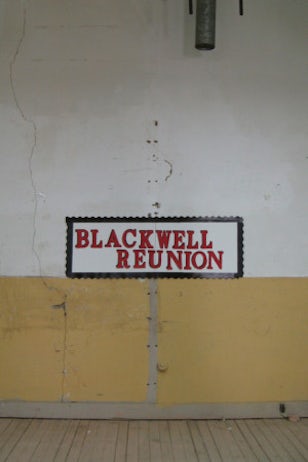
By the time I visited Marfa in 2007, another Blackwell Reunion was about to be held and something – an unspecified politicization of sorts – was transforming what would the generally apolitical nature of an American school reunion. The organisers of the reunion, the Blackwell graduates who had remained in Marfa, had radicalised and were now asking the town to recognise its legacy of segregation and perhaps, flirting with the possibility of underscoring its current bifurcation. In the proceeding weeks, the planning committee strategically placed matted photographs of Blackwell’s student classrooms, clubs and sports teams in the windows of businesses throughout the entire town. The images, festooned by red and black paper garlands, circulated through neighbourhoods where, previously, only whites had lived, and Latinos only visited, entering homes and neighbourhoods to clean floors and mend fences. The Blackwell Reunion Committee was re-imagining the surface of Marfa and employing a self-styled form of site-specific installation in the process, collapsing the time continuum in order to conjure a space where small town majorettes and football players of obvious Native American descent, and sometimes just as obvious relation to the Anglo ranch families, were as championed as their white counterparts.
When we spoke on the phone, Joe Cabazuela, a Blackwell alumnae and committee member, extended the psycho-geographic nature of this struggle. He said he and other members of the football team wore the cast-off uniforms of the Anglo high school and practiced on the Anglo high school fields but were not allowed to shower in the white locker rooms after practice. The boys crossed back over to their own neighbourhoods and washed there. Now that the Blackwell committee was in the process of building the new Blackwell School Museum, which unlike the others in town was directed by and not solely maintained by brown-skinned people. I thought of Mierle Ukeles Laderman, who in a 1973 performance at the Wadsworth-Atheneum, in Hartford, Connecticut, washed the floor and entranceway during public hours – advertising the exclusion of women from the art realm as well as the greater cultural perception of women’s role and use value. Could this strategy also wend its way into the arsenal of techniques employed by the Blackwell Reunion Committee? By cleaning these transplant art institutions without payment and orders would the Blackwell alumni in fact, make transparent a role that still persists in Marfa? Or was this just one more useless effort?
The Blackwell Reunion Committee would probably not see themselves as sharing an alignment with Ukeles Laderman or the Situationist International and its desire to transform society through a reorganisation of how we perceive, define and defy the grid of social and economic relationships. At the same time, the Committee’s visual reorganisation of cartography based on errant bodies wasn’t wildly divergent from the psycho-geographic practices enjoying a renaissance in metropolitan art organisations in the US.02 For sure, the behaviour of the Blackwell students can be scripted in the manner of a Situationist slogan: ‘All space is occupied by the enemy. We are living under a permanent curfew. Not just the cops – the geometry.’03
But former Blackwell students do not need to borrow the language of revolutionary intellectuals and artists to articulate the ways in which active hierarchies have lacerated and divvied up territories. The actions of these rural organisers demonstrated that they intuitively understood that the geometry of their town underscored and sustained racial stratification. Its geometry was generated by three separate law enforcement agencies (local, county and national) and a jail; by a town hemmed in by vast ranches, some replete with histories of dubious labour practices. It had also been framed by an internal border patrol station on the south end, a surveillance blimp on its western outer reaches and by an old cemetery at its westernmost reaches, where a crude fence still divides the grounds in two. On one half lies a dirt plot studded with homemade cement headstones and the stick remains of rotted wooden markers, and a broken down shed with several empty beer cans resting on their side at the threshold of miles of ranch lands. The other half of the cemetery is markedly different; well-maintained store-bought headstones rest amongst grass and trees. The surnames on the broken and barren side are primarily Spanish, while the surnames on the other are primarily Anglo. Pronghorn antelope come to graze, wandering through either side. When they are ready to return to the plains they do not leap over the barbed wire fences but slide under the lowest wire; coyotes sometimes lie in wait at these thresholds, attacking their prey as they lay midway between one space and the next. Coyote also serves as another name for those who illegally transport people across the border.
*
According to historical record, the first cemetery in Marfa was owned by August Coma. After one flood, fifty graves remained. The others had drifted away, swept down Mimm’s Draw, a geographical feature that could be described as sometimes creek and sometimes ditch, depending on the time of year. According to papers found at the town library, the house at 407 W. Texas Street used several of these water-borne tombstones for its back-steps. It was during the dry season that I walked down the snaky draw, and turned onto West Texas, searching for the morbid handiwork of some inveterate recycler; but the staircase wasn’t there anymore. It, too, had washed away.
I began to wonder how one organises such a surfeit of absence, emotionally and intellectually, in a town where words and bloodlines have been buried and in a desert where the dead have floated away. I was wrong in thinking that by starting with the tombstone staircase – a material survey of the crawlspace between things – some light would be shed on the indiscreet swapping of dead, sacred, living and unholy. The last vestiges of the threshold were not to be found in a makeshift search through houses and ditches, but rather in language: August Coma, Coma, Koma. Koma: borrowed from the Greek by both Spanish and English, translates as ‘deep sleep’. Mr Grand Deep Sleep… so reads the freshly translated name of the owner of the first burial grounds in Marfa. What could more aptly describe the interstitial nature of the threshold than ‘Grand Deep Sleep’? Both states, threshold and slumber, bear intrinsic instability. Which elements of these instabilities are possible models for political strategies and/or aesthetic tactics?
*
Not unlike some of the Situationist-oriented contemporary art groups, Texas’s Blackwell Committee was preoccupied with bodies, space and place. They were committed to reminding the town of its just buried legacies and in response activated the entire grid of the town in order to shift the nexus of power and did this, as mentioned previously, by papering all sections of the town with reproductions of former Blackwell students in marching band and football, homeroom and so forth. This committee’s politics were not impersonal but tender, potentially crushing themselves as much as their opponent; crushing their desires as much as their fears. Their furious attachment to known geometries was touch-and-go. They proceeded with uncertainty. Some back-pedalled and expressed that they didn’t want to offend anyone. I detected a strategy based on hovering; however it is more likely that they were guided by a ‘politics based on a model of tears’, as Eduardo Cadava phrases it: ‘When we usually think about acting politically in the world, we look at a situation, we analyze it, we evaluate it; and then on the basis of that analysis and evaluation, we decide what we think is the best way to proceed. This means that acting politically in the world is generally based on a model of vision. But when we are crying, we cannot see things clearly.’
Thus, pursues Cadava, a politics based on the model of tears would be a politics that ‘takes its point of departure from the presupposition that we always act without seeing things clearly, that we always act with tears in our eyes’.
And if a taxonomy of these sort of tears was to even be attempted, it would have to include the ways in which water (and its behaviour) in contested terrains stands in for the tears that humans sometimes refuse to shed. In Marfa, a local builder described caliche as an ‘impossibly hard layer of mineral-laden soil throughout this desert region, usually a few feet below the surface’. It is formed by water (either rainwater or rising and falling water table) moving up through the soil and carrying minerals suspended in the water. When the water approaches the surface, it evaporates, leaving a hard calcium carbonate layer of soil. Caliche often serves as a natural foundation in old adobe structures, such as the Blackwell School.
Within our discussion, the builder noted that a connection can be made ‘between caliche and the crusty film on our cheeks after a good cry’. Then we can begin again to observe what is not only built from a politics of tears but also from a close observation of ‘the interface between what is below ground and above ground’. Perhaps the aggrieved could negotiate tears as they would a body of water, swimming adeptly through them, instead of sinking down.
*
Three times – at her dinner table, on the street, in her office – the inimitable Frances Rojas told me the same story, a story born by water and at its core, the art of negotiation. She repeated her story because she was looking for a way out, attempting to circumnavigate dubious efforts and museums as mausoleums. She spoke of Redford, 75 miles from Marfa, a village on the Rio Grande formerly called El Polvo, which translates as ‘dust’. The name was changed when the US Post office officially rejected its Spanish one. It was there, by 1979, that Lucia Rede Madrid, a retired schoolteacher who had worked for the Marfa and Redford school district for 23 years, opened her own private lending library within her husband’s dry goods store. There were over 10,000 titles in Spanish and English in her library. For years, Mexican children would wade across the river, from Mexico to Texas, select a book, carry it over the river, read it and return it, repeating the process again and again. No checkpoints. No passports. The drawings, made in marker and given to Mrs Rede Madrid by the children who crossed the border, are bright and funny. Often, Rede Madrid is depicted lying in a canopied bed, dreaming of books; they hover over her. This was the story told to me by Mrs Rojas three times over.
‘Do not think that one has to be sad in order to be militant, even though the things you are fighting are abominable.’ So goes Michel Foucault’s wise command and it nicely dovetails with this river parable of flying books and anarchistic children. The transgressive joy perceptible in those children’s pursuit of their own education can inflect the way one understands the politics of the former Blackwell students. Each struggle lies at the nexus of education, bodies and language. But one struggle is so heavy and the other, so light.
Slightly shifted, Cadava’s entreaty potentially transforms the so-called uselessness of weeping and propels the former Blackwell students outside the limits of the sorrowful institution that the Blackwell School Museum and Community Center could have been, and still might be. Calling out for someone, the weeper has a purpose. He feels his way towards aid and succour and shelter, imagining that beyond a dense lens of tears is someone, something who will listen to a noise that comes out of the body but isn’t language. He knows that someone will rescue him from a trauma for which there is no word. And furthermore: ‘It is also important to note that the tear that falls does so at the frontier between the public and the private. The tear signals a kind of dissolution or melting of the self at the moment when one is trying to make this or that decision.’
This temporary blindness and the manner in which crying simultaneously obscures the sight lines to the interior and exterior allows the weeper to imagine the best of worlds, the relief of a land restored after the flood recedes. But where does the tear fall – and in a frontier land savaged by borders made of water (the Rio Grande) and the vibratory site lines of surveillance (physical and virtual) – in what guise?
*
More tears.
In this part of West Texas, before English supplanted Spanish, the language of the conquistadors eradicated Nahuatl, an Uto-Aztecan trade language emanating from the south. Previously, Nahuatl had gradually supplanted Jumano words spoken in some villages along the Rio Grande. The Mescalero and Comanche languages were also colonised by Nahuatl, Spanish and English, and none of these local, ancient languages is spoken today in Marfa. This process of removal began when loaner words in Nahuatl (and later Spanish and English) replaced their indigenous counterparts for trade items, but certain words in any mother tongue are more stubborn than others. The word for water is usually one of the last to go… agua, paa, tu, t ‘on. Which one – Spanish, Comanche, Apache or Kiowa – lies within this town’s crypt and which doesn’t?
The town library has collected photographs of these errant waters: live bodies up to their thighs, a locomotive racing over the bright plain towards a terminus eradicated by water, a blonde high-school student carrying a mock-up of an illegal immigrant’s claptrap canteen. Another fuzzy Polaroid from the library’s archive of high school projects – this one an essay detailing the supplies and strategies utilized by Mexicans illegally crossing the border as they travel through the desert surrounding Marfa – features a close-up of a plastic jug, suspiciously similar to a cleaning supply bottle, and its rope handle. This toxic facsimile of a water jug lies on the desert floor between the spikes of a Yucca bush and a large red rock the size of a human head. By the strength of the light and the depth of the shadows, one can tell that it is still morning and so this border-crossing re-enactment, for all its impudence, gets one thing right: the beginning of the day is gentler on the traveller. The desert is still cool and if an immigrant were still furtively scrambling across the Upper Chihuahuan desert, he might not be desperate for water yet. But as the sun rises in the sky, the traveller may become more desperate. According to a retired border patrolman I interviewed last summer, sometimes the border patrol come across a man’s trousers and shirt before the body of the man, living or dead. This array of clothes signals his thirst and his exhaustion, his probable end. When they find the body, it is not uncommon that the traveller has torn up the earth all around him. Although he is deliriously searching for water, he appears to be digging his own grave.
Could it be said, in consultation with Cadava, that within the collective public consciousness of West Texas, water stands for charged tears as a temporary medium that potentially shifts perception if we can read through it? One can thus argue that tears are a condensation that collects on the polarised surfaces of this town, and that weather itself becomes a conduit for emotions that are publicly denied. If this is a psycho-geographic given, the seasonal heavy floods and their residual dry creeks stand in for a sordid imbalance transmogrified into sweat and tears… unwashed athletes… invisible immigrants and prodigal sons and daughters crossing the desert without water… A pale-skinned woman at the Blackwell reunion tearfully describes being ordered by a teacher to wash a dark-skinned student ‘clean’ … Here is a medium in excess.
What is not buried under water is buried in soil. During the Blackwell Reunion of 2007, two hundred people assembled for the exhumation of Mr Spanish, an effigy of sorts buried by Anglo school authorities in order to enforce English-speaking. This disinterment as performance was intended to symbolically reverse the previous suppression of Spanish by school authorities, becoming the school’s agent of enforced English speaking. When the Blackwell Reunion Committee initially decided to disinter Mr Spanish, the grave could not be located; the committee then orchestrated a performance, where the contents of the grave suddenly included an actual figure. This allowed for Mr Spanish to be exhumed yet remain buried. Both dead and live, ‘he’ is nowhere and everywhere and language, as absence and presence, grids the ground. For myself and a few other outsiders, there was the misguided notion that something resembling the body of a man was to be pulled from the dirt schoolyard, something more like an effigy than a human. But what was disinterred from a shallow grave, dug expressly for the reunion, was a newly made child-size coffin with a book inside of it. In unremitting sunlight, Maggie Marquez, a local librarian and Ralph Melendez, the temporary gravedigger, both former Blackwell School students, held the new coffin aloft. Next, they lifted their fists to the air. Then Maggie raised the book to the sky – a small Spanish-English dictionary – and the plastic orange and red cover hovered for what seemed a while against the blue sky. The crowd, dressed in their old school colours, cheered.
The ‘original’ Mr Spanish was buried in a ceremony under the flagpole on the Blackwell school grounds in 1954, though this grave cannot be located. 04It lies somewhere underneath the public housing development and above the subterranean aquifer that supplies the town with its water. In that middling stratum, if anything remains at all, it is something that less resembles a crumbling infant skeleton in a pauper’s coffin, so much as a shoebox stuffed with disintegrating paper. For indeed, there never was a body, never a flesh and blood Mr Spanish. Both mock coffins, contemporary and mid-century, were filled solely with language. In the original burial, in a gesture that was so conceptual it was skipped in the re-enactment, students were instructed to write ‘I will not speak Spanish’, and place the strip of paper in the coffin. However, the Blackwell organisers were visibly desperate for abody; the newer burial included a tiny sombrero-wearing doll draped in a bright serape.
Why did the organisers stray in their reconstruction? Was this simplification a way of saying no to dizzyingly complex permutations of language? Did this reconstruction reject a ‘tradition of the unbelievable’ – a tradition born of the linguistic and physical accommodations demanded by conquerors and replete with complicated performances (stand-ins, coded songs, double-speaks), tipping an entire population into something we now deem the surreal? And now, reviewing the number of transmogrifications (of language) in this instance, can it be claimed that this performance underscores an ever mutating loss? It isn’t clear. Something so consumed with loss, may in a sense, be losing it. Here loss, in the form of language, shape-shifts – from the Spanish language (a non-living form) to living body (Mr Spanish), from corpse (a buried Mr Spanish) to resurrection (a stand-in Mr Spanish). Potentially overwhelmed by a daily life conducted under a mantle of unrelenting magic realism, is it not so surprising that the organisers returned to a simpler, older set of signifiers – a miniature but authentic coffin instead of a shoebox, a racialised effigy over a collection of schoolyard affidavits masquerading as the sign of the law.
After the performative reversal of Mr Spanish’s burial, The Big Bend Sentinel, the local newspaper, published a letter in which the writer claimed that the town was too fragile to bear the performance. She argues that an examination of history could ruin this town. It seems far more likely that a lack of water will do Marfa in than a collective introspection. According to Robert Silva, Marfa’s public works director, the metropolis of El Paso has bought the water rights that extended as far as Valentine, 25 miles west of Marfa. Sixty-six miles to the south, the lower Rio Grande is choked by salt cedar and may soon be enclosed by a wall. Now the remains of Donald Judd’s fantasy to bottle Marfa’s water and sell it at the upscale New York City grocer Dean & Deluca are displayed in one of the Judd foundation storefronts on the main street. These thick globular glass bottles and the wooden mould that shaped them seem mostly souvenirs of a more naive time. A time when there was little audible talk of Mr Spanish and when the empty buildings (ranging from a closed bank to a mohair warehouse) would, to an outsider like Judd, look more like an opening in the ruins and less like a collection of crypts. In other words, vacant buildings presented themselves as architectural and curatorial opportunities, rather than appearing as the locus of a localised battle.
*
Eusebio L. Ramirez, a musician who graduated from Blackwell in 1957, pulled his car over when he saw me taking pictures of the closed school. Sitting in the front seat, he was the one who told me that although the students were not allowed to speak Spanish, they could play Spanish-influenced marching music. The Blackwell marching band travelled seventy miles south to the town of Redford, Texas (formerly the town of Polvo) to play Mexican marching songs on the steps of the Redford village store. Half of the songs were about birds, one specifically featuring a fairly out of context seagull. Some claim that the name Marfa is a Spanish-English creolisation – Mar Fa, meaning ‘far from the sea’. Again reality begins to exceed itself:
Picture for a moment the marching band of a landlocked desert village-named after the fact of its distance from the sea -travelling seventy miles to a river to sing a song about a seafaring bird. Furthermore, realize that the town they are marching in was once called Dust (translated from the Spanish) and is, as of today, September 17th, 2008, under water because the river has breached its banks.
I imagine that back in the 1960s the Blackwell students sometimes longed for thefrontera of Redford, for a site where language and nation were more fluid – for a village without a segregated school. After the concert, the students would then return to their own school in Marfa where it was as if a shared border culture was simply imaginary. The rhythms of Spanish hid out in a semi-evacuated from – in the palimpsest of a mestizo tune.
In his work on New Orleans and the performance of trauma, Michael Roach states that an existing community can further coalesce by coming together ‘around a corpse that is no longer inside but not yet outside its boundaries’. So although Blackwell School officials clearly stated that ‘Mr Spanish is dead [and] only English will be spoken here’, their so-called corpse staggered and sang because, as Maggie Marquez declared, ‘they could not bury our culture’. Spanish was still spoken and sung by students on school grounds, be it followed by a beating from the principal or celebrated in the form of the ranchera.05Elodia Guerrero Contreras, a small, beautiful old woman who has returned to Marfa for the reunion recalls: ‘I’ve been singing. I used to sing rancheras every Friday. [The teacher] would have the whole class finish up so I could stand in front and sing.’
But stories aside, what begins to emerge is an extra-legal entanglement located within a collection of towns with shifting names and plastic rules. Singing became the exception in the pseudo-legal prohibition of the Spanish language perpetuated by the school. The voicing of words in that machination of throat and breath and tongue we call song can potentially alter the course of indoctrination because they distort and stretch the boundaries of cognition. As song, the words are perceived as useless (that is, not economic or overtly political) and it is presumed that they cannot take a concrete form. In other words, authorities forged their own logic – a logic that claims that melody evacuates all of the tongue’s intentions other than pleasure. Because of this errant logic, songs oft escape surveilling mechanisms and the anti-architecture of this type of song allows it to defy the institutions and its crypts; its live and unrecorded form forges an unpredictable path (spatially and improvisationally) that temporarily allows for our euphoria and abjections to be voiced without filter, retribution, or to be harnessed for another’s economic gain. And ultimately, because song tests the limits of pronunciation, bending words to fit the notes, the listener is filled with unspeakable, erased languages, Spanish and otherwise.
*
‘Are you telling the “trail of tears” story’, the above-mentioned builder wrote to me, ‘about how they made the kids carry their own desks to the white school after integration?’ In 1965, the Blackwell students, kindergarten through eighth grade, were instructed to carry (by hand) the textbooks, school supplies, and desks one mile to what would become a newly integrated facility. A possible response to the builder’s question, beyond a simple affirmation, is to tell him that record of the desk removal and its composite child labour could very well be archived in the Museum of Useless Efforts-Marfa. For what masquerades as legislative and practical becomes undone here-transformed, up-ended, and perhaps, perverted. These so-called useful efforts, as illustrated by the desk removal, construct and perpetuate a grand narrative of inevitable obedience. They instil the notion that ‘necessary sacrifices’ are part and parcel of a form of racial progress, in this case a forced (unwanted and undesired by whites) desegregation. The Marfa Independent School district found it useful to not dispatch its own trucks; that is, to use the children as day labourers on the day that Marfa was court-ordered to desegregate its school system and bring the children from Blackwell to the main school. To be used, to be useful, to be useless. The children manage to fall through each category simultaneously.
Of course, by naming this incident ‘The Trail of Tears’, the builder conflates it with another American genocide enacted on a vaster scale. But his slippage also indicates that a ‘politics of tears’ is at play. But which tears? In this instance, this last-ditch punishment, enacted by white administrators, presumes that the tears issue from only one source. Although the easiest discernible lachrymal well is the sweat and maybe actual tears of the children carrying their heavy desks northward, is it possible that the administrators have their own tears to shed: the ones falling but hidden just behind the face of their crumbling order. And finally, what is the more useless effort in this instance: to probe the source and trajectory of villainous tears, or to comfort the administrators in their sleep, where they have sunk deep into a coma- a coma induced by a habituation to power?
In a politics built by language and water, what floats? What evades? If we take on a form of formlessness, rife with slang and perpetually boggy, will we truly give vertical hierarchies and ideological straitjackets the slip? Maybe. Furthermore, if, on a sociological and geophysical level, one recognises that watery political borders have universally begat the smuggler, it may follow that to co-opt the smuggler’s talents is part of a radical internalization of a broader estuarine ecology.
So while we may hope to steal the smuggler’s stealth, will, and love of the night, we also fear her back-against-the-wall violence and our complicity with what we imagine as her thirst. (Her thirst consists of a rather Rimbaud-styled confluence of abandonment, lust and disappearance; that is, the desire for self-eradication, lust for riches and the abandonment of language, formal and lyrical.)06But this sifting through contradiction is central to an inclusive politic that necessitates a continuous negotiation of what we can and cannot perform and it is because our will is liquid. It demands that an unearthed creolized speech flows through standardized languages and it includes illicit pleasures borne by smugglers- whether it be books or drugs in the hold of the boat; oxygen or prayer held in the closed mouths of passengers. 07 All of this, because we need to ask ourselves: what do we need to make it on the water?
Let us try, then, for a politics that rebels against the architecture of a built environment – ranches, schools, museums, crypts and burial grounds – a politic that echoes the behaviour of a river that cannot isolate its past nor stand in place, a politics in motion. Given that, instead of a potentially flooded and inevitably stranded Museum of Useless Efforts, I imagine a floating orchestra. The raft is humble and tacks, without destination, from bank to bank. Melodies, political and pleasurable, salty and clean, carry over the water.
– Mary Walling Blackburn
Footnotes
-
Rossi was a novelist forcibly exiled from Uruguay, during a period in the 1970s when government detractors simply disappeared. She fled to a Franco-controlled Spain, making passage from one totalitarian regime into another.
-
Such as Fallen Fruit, PIPS, Psy-Conflux, Red 76.
-
Raoul Vaneigem, ‘manifesto of unitary urbanism’, Leaving the 20th Century: The Incomplete Work of the Situationist International (ed. Christopher Gray), London: Rebel Press, 1998, p.26.
-
As early as 1930, the court makes record of judicial opposition to segregation within Texas. The Independent School District of Del Rio, another border town, was accused of categorically segregating Mexican-American children based on their race, but the ISD successfully argued that the separation was based on language incompetence. In 1948, in Delgado v. Bastrop ISD, it was stated that the district’s segregation policies violated the 14th Amendment. By 1954, Brown v. Board of education determined race as an illegitimate category in determining student body. However, school districts throughout Texas were able to circumnavigate the decision by claiming language as their basis of exclusion because of laws passed by the Texas state legislature that enabled school districts to defy federally mandated integration.
-
A ranchera is a twentieth-century Mexican ranch song characterized by lyrics of love and land and sonically by its plaintitive and extended glissando.
-
See Maurice Blanchot’s essay, ‘The Sleep of Rimbaud’ in The Work of Fire (trans. Charlotte Mandell), Stanford: Stanford University Press, 1995, pp.153-175.
-
An estuarine politic of sorts will not be for everyone; some will consider it a sort of modern burial at sea. This type, if forced into the river, will lobby for floating museums and sizable houseboats in an attempt to institutionalise the water – if the water will let them.