

Haris Epaminonda is a Cypriot artist who has lived in Berlin since July 2007, when she started a residency at the Kuenstlerhaus Bethanien. Epaminonda’s work was recently shown at the Berlin Biennial (2008) and at the Cyprus Pavilion of the Venice Biennale in 2007, where she presented Tarahi IIII, V, VI (2007), a three-channel video installation that forms part of her ongoing series of short films sourced from re-edited sequences of found footage.
Epaminonda works in a mode of assemblage, often processing the content of found images and footage. Playing with synchrony, symmetry, repetitions and cuts, she uses magnified colours as well as orthodox black and white, and often simple optical effects, in her installations, collages and video alike. Cultivating an interest in the written word and privileging images from the past particularly from the late twentieth century Epaminonda evokes a remote time and space, adding one degree of separation between us and the representation of our reality.
SONIA CAMPAGNOLA: Where did you study in London?
HARIS EPAMINONDA: I got my M.A. at the Royal College of Art, in London. I finished my studies in 2003.
SC: Did any of the artists or teachers you met and studied with influence your work?
HE: Yes, very much, especially Jonathan Miles, who teaches in Humanities Studies. I was in the printmaking department, but from the beginning I thought I was in the wrong place and decided I was going to do things that did not quite fit the department. That is when I started experimenting with video.
SC: You studied in London, but you grew up in Cyprus. How do you feel now, when you go back to Cyprus? Does your work have roots there?
HE: I like its dryness… I feel a strong connection to the memories of my home and my family. The years I lived in Cyprus have influenced my way of seeing things, but I cant say its a source for my work itself. Its more my thinking of home. Something I miss is my language sometimes I get frustrated, so I write. I always keep a diary with me, with what I do and my thoughts, especially when I travel.
SC: You live in Berlin now, and you are taking part in this years Berlin Biennial with your installation,Untitled(2008), at the Neue Nationalgalerie. Whats the story behind it?
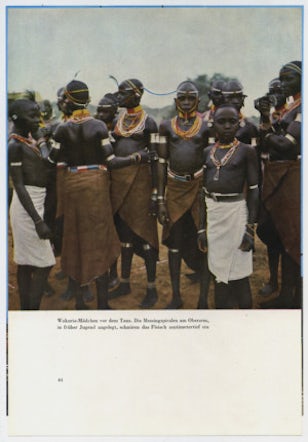
HE: In the beginning I wanted to show a new series of collages together with the project The Infinite Librarythat I am working on with [German artist] Daniel Gustav Cramer. We work mainly by focusing on books from the 1920s to the 1970s. We love the way the ink sits on the paper, and look for images that have an abstract quality. One can sense the time that is lost. We use mainly picture books, putting one part of a book on another.
SC: What kind of picture books?
HE: All different subjects from architecture, animals, sports For instance, we might combine architectural sketches and images from 1932 with pictures of gems and somehow see that these two different subjects belong together so, for instance, page one of an architecture book might be followed by page 37 of a different book. Each book is numbered and re-bound. For example, N.4is a double book, where we found two of the same books and combined them into one.
SC: So, the original content of the book is no longer the same. Does each book have a topic in the visual associations you apply to it?
HE: Each book has its own system made of a certain rhythm, pattern or strategy. We treat the old picture books as what they literally are a number of pages bound together to create a book object. The starting and end points are always books: images and texts contained within the covers. Dismantling and rearranging them means causing an interruption to their original system.
SC: Experimenting with random associations of words and images is an old method think of the historic avant-garde, with games and jokes such as the cadavre exquis and the automatic poetry of Surrealists, Dadaists and Futurists, and later on that of Fluxus, John Cage, experimental cinema and so on. What is your take on these historical precedents? What is the shift that makes what you do different from what they did?
HE: I wouldn’t really be able to say. In The Infinite Library, pages are not taken out of the book content and transformed through collage, assemblage, etc, into new kinds of works. They remain as books, and by shifting the content, several parallel worlds can co-exist. There has been a radical change in the process of knowledge production and dissemination through recent developments, the Internet in the first instance ‘the web of all potential knowledge’, in a rhizomatic organization. The books of The Infinite Library turn transmittance into a similar loose conglomerate filled with dead ends and chances. Its not a library in the sense we know it, but merely an image of it. When we started working on it, we also thought of Borges and his idea of the Library of Babel.
SC: Is this the first work you and Daniel have done together?
HE: We did other works together, since we graduated from the RCA, such as The Beehive, an online project based on the associations of true and fictional stories, images and sounds. Daniel works a lot with books, and we had both been looking at found images. Ideas just flowed.
SC: Lets go back to the piece you prepared for the Berlin Biennial.
HE: In the beginning, I was allocated to the Kunst-Werke but the curators [Adam Szymczyk and Elena Filipovic] felt my work was better for the Neue Nationalgalerie. I already had some works in mind, and so I built the room around the collages and books I knew I wanted to show. I thought of creating a space where all the elements would exist on their own and at the same time refer to each other. The built glass panels reflected Mies van der Rohe’s architecture. Meanwhile I also decided to use a few sculptures from African tribes that I set on plinths, where they referenced elements within the images on the wall, which, in their turn, resonated with elements from the 1950s and 60s the time period of the museums architecture. The vitrines were also a van der Rohe design. In the end, the room feels like it has always been there. I wanted people to go in and not really know which parts were the work. I also needed some movement, to give it life, so I thought two goldfish and plants would create the ambiance I had in mind.
SC: The room recalls the display mode of anthropological museums. Working on it, were you thinking of museology and how the selection, display, and association of different elements give a different interpretation of history?
HE: Oh, yes. In many ways this work looks at how institutions present things, and the importance of the word display. If you see the same object in a different environment, its meaning is transformed; and it is influenced by what might be hanging or standing nearby, behind or around it. For my part, I tried to create an image, a mood. It is a life-size image with a frame around it. The process of association is the same as that of the collages, just on a different scale. I took something existing and I worked around it.
SC: The same cut-and-paste process recur in the series of short videos titled Tarahi IVassemblages of fragments from found videos and films. First of all, what does Tarahi mean?
HE: Tarahi is a Greek word, in English it translates as something like turmoil.
SC: Lets take Tarahi VI. How did you realise it, where did you source the images and how did you choose the music?
HE: The images were taken from Greek films of the 1960s. I chose the ones that I felt closest to. I never know what I will come up with but I generally have a strong feeling of how to work with images and sound. It is all about rhythm and the way things come together. Robert Bresson says: …you take two images, they are neutral, but all of a sudden, next to each other, they vibrate, life enters them…. This is what I feel with moving images, it is what you do with them and the order they appear in that can trigger a movement not just motion but also emotion. Of course sound plays a big role as well. In this case, one piece runs through Tarahi IIII, V, VI Alexander Scriabins Tenth Sonata [1913].
SC: Bressons work is a point of reference in your work, whom else you find important to observe?
HE: Photographer Luigi Ghirri and Bresson are the two names I can think of right now. Both of them have left deep impression on me.
SC: What are you working on now?
HE: I am gathering the material I have filmed with a Super 8 camera. I filmed mainly animals for the moment. I would like to create an octagonal space where each side is a screen for a projection, so you can turn around yourself and view them all at once like a panorama.
This interview was recorded at Haris Epaminonda’s studio, in Berlin, April 2008.
– Sonia Campagnola